


From in-depth diagnostics to comprehensive therapy - all in one center
Treatment of Speech and Language Disorders in Barcelona
At KidiMind, we do not reduce all speech concerns to a single type of speech therapy. We build differentiated pathways: a separate one for childhood apraxia of speech, a separate one for phonological disorders, a separate one for language disorder, a separate one for motor - speech profiles. Precise diagnostics determines what exactly will help your child.
Speech and language disorders are different conditions requiring different approaches
Behind the general term «speech disorder» lies a group of very different conditions: some are related to speech motor skills, others to the language system, others to the sound system, and others to comprehension. Each requires its own approach.
International approaches (ASHA - American Speech-Language-Hearing Association) emphasize the need for detailed differential diagnosis before starting therapy. «Just a speech therapist» without a precise understanding of what exactly is wrong with the child loses time and often works with an ineffective protocol.
In cases of significant difficulties, when oral speech is insufficient for everyday communication, AAC (Augmentative and Alternative Communication) is considered - a system of alternative communication that gives the child a way to express wishes, emotions, and needs.
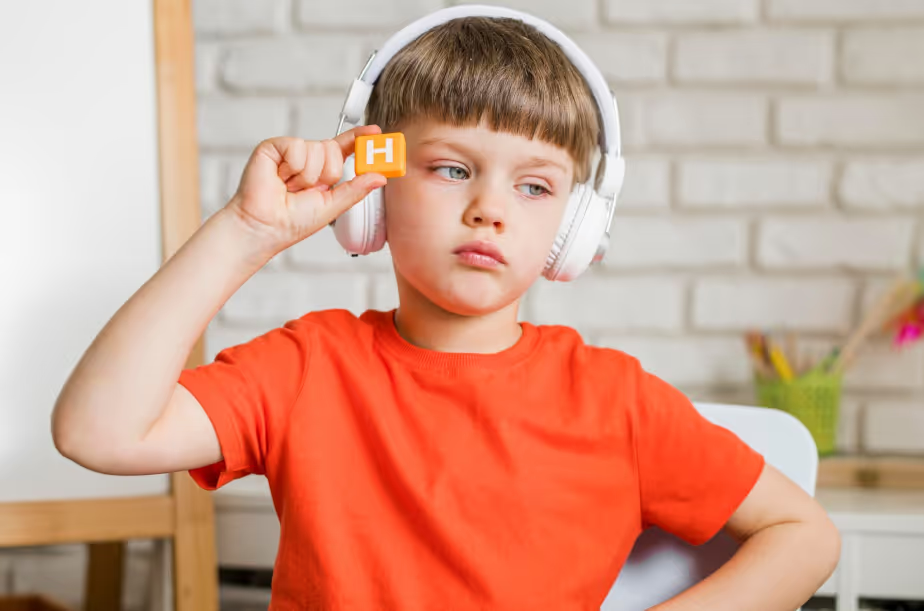
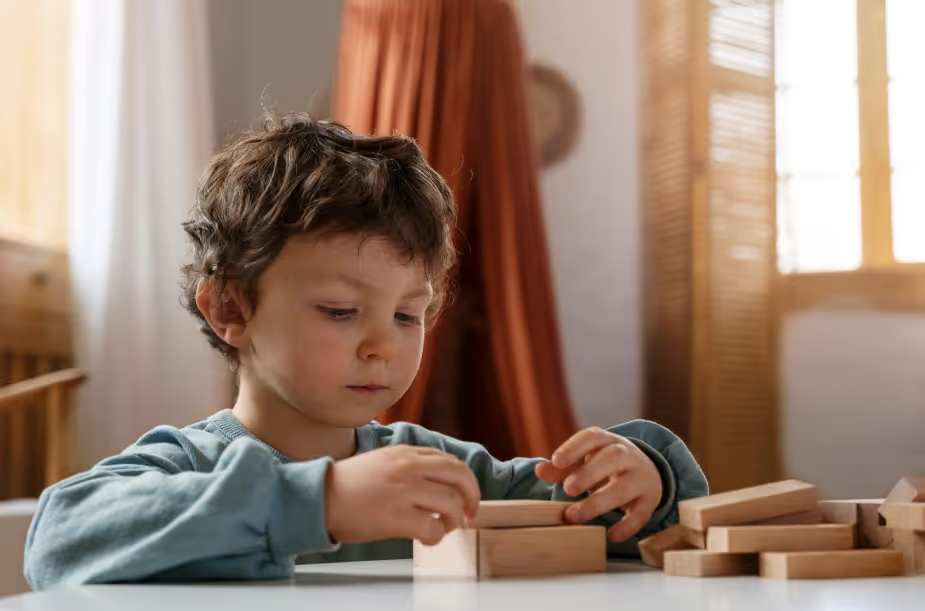
Types of speech disorders in children
The exact causes of ASD are not fully known. Modern science agrees on one point: autism is the result of the interaction of many factors, primarily biological.
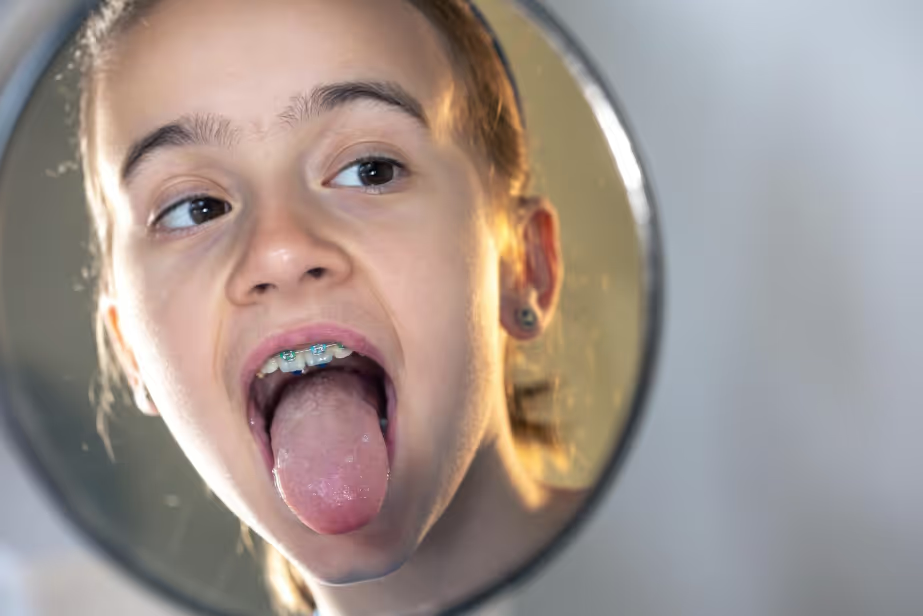
Языковое расLanguage Disorderстройство (Language Disorder)
Difficulties understanding speech, limited vocabulary, grammatical errors, weak connected speech, problems with pragmatics (using language in communication). Often not noticeable «from the outside», but interferes with learning and socializing.
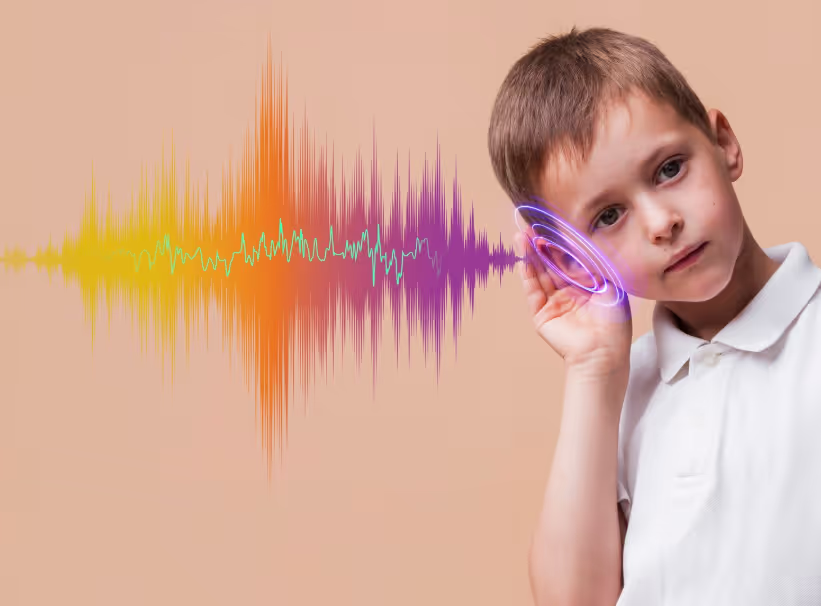
Phonological Disorder
The child incorrectly uses the sound system of the language: mixes sounds, simplifies words, speaks in a way that is hard to understand. Not to be confused with age-appropriate norms - in children with this disorder, these patterns are persistent and systematic.
Childhood Apraxia of Speech (CAS)
A disorder of motor planning for speech: the child knows what they want to say, but the brain cannot organize the precise sequence of articulatory movements. Speech is inconsistent, with different errors when repeating the same word.

Dysarthria
A disorder of the motor aspect of speech due to weakness or impaired coordination of the muscles. Speech is slurred, voice is altered, tempo is disrupted. Often occurs alongside other neurological conditions.
Signs of speech disorders by age
These reference points are a reason to seek a professional evaluation. Hesitation with speech disorders costs more than an «extra» consultation.

Under 2 years
- Does not respond to name or spoken address
- No babbling by 12 months
- No single words by 18 months
- Does not point to objects, does not imitate
- Does not understand simple requests


2–4 years
- No phrases by 2–2.5 years
- Speech is unintelligible to strangers
- Does not answer simple questions
- Limited vocabulary, repeats the same words
- Errors differ significantly from age-appropriate norms
- «Forgets words» they knew before (regression - a warning sign)

5 years and older
- Speech still unclear to others
- Mixes sounds, simplifies complex words
- Limited vocabulary, short simple phrases
- Difficulties with retelling, describing, storytelling from a picture
- Difficulties understanding instructions, long sentences
- Shy about speaking, avoids communication
Take the first step
Book an initial consultation. In a single session, we'll gather your child's history, outline working hypotheses, and explain the support pathway that fits your child's unique needs.
Carrer Viladomat 135, 1-1, Eixample, 08015, Barcelona
Mon-Fri 10AM-6PM
Mon-Fri 10AM-6PM
What can underlie speech disorders
Speech difficulties are not a separate «illness», but a symptom that can have different causes behind it. This is exactly why comprehensive diagnostics are more important than «just going to a speech therapist».
Possible factors:
- Reduced hearing - the most commonly missed cause of speech delay
- Neurobiological differences - brain areas responsible for speech and language function differently
- Motor features of the articulatory apparatus - in dysarthria and apraxia
- Autism spectrum disorders - speech may be part of a broader profile
- Genetic factors - some speech disorders have a hereditary component
- Deficiencies and metabolism - reduce brain energy, interfere with development
- Sensory features - oral sensitivity, feeding difficulties often co-occur with speech issues
Important: Parenting, bilingualism, and «too many gadgets» are not independent causes of speech disorders. A bilingual child may temporarily speak less - but this is normal, not a disorder. A disorder is a persistent delay that cannot be explained by environmental factors.

Speech is not just language
Speech develops at the intersection of many systems: articulation motor skills, hearing, attention, memory, sensory regulation, motivation to communicate, environment. If we work only with «sounds» - we are touching only the tip of the iceberg.
That is why, in cases of speech disorders, we simultaneously:
- check hearing - mandatory, without exceptions
- assess the motor-speech aspect and differentiate apraxia from dysarthria
- examine language as a whole - comprehension, grammar, vocabulary, pragmatics
- review the sensory and feeding profile - oral sensitivity is often linked to speech
- consider attention, memory, and cognitive foundations
- address deficiencies and metabolic factors, if present
- introduce AAC if the child is struggling due to inability to communicate
This allows us not to «shuffle» the child from one speech therapist to another for years, but to quickly understand what exactly is the issue and build a precise plan.
What we do differently
Individual pathway for every child: from addressing challenges to maximizing potential.

Precise differential diagnosis
Not «general speech therapy», but identification of the specific type of disorder: apraxia, dysarthria, phonological disorder, language disorder. The therapy protocol depends on this.
Mandatory hearing screening
Audiological screening - a basic part of diagnostics. Speech therapy without addressing reduced hearing is ineffective, and we do not start therapy blindly.
A team instead of a single speech therapist
For each case, a speech therapist, neurologist, neuropsychologist are involved, and when needed - OT and nutritionist. Speech is not just «sessions with a speech therapist».
Readiness for AAC
If oral speech is insufficient for everyday communication, we introduce AAC - so the child can communicate right now, not «when they start talking».
How we diagnose speech disorders
The goal is not to «confirm a delay», but to understand the specific profile and cause, in order to build a precise program.
Basic assessment (for all children):
- Comprehensive speech and language evaluation - speech comprehension, expression, vocabulary, grammar, connected speech, pragmatics, sound system
- Motor-speech and dynamic assessment - especially important when apraxia is suspected: movement accuracy, dependence on cues, prognosis
- Oral-motor and oral mechanism exam - differentiates apraxia from dysarthria and other motor speech disorders
- Audiological screening - mandatory for any speech difficulties
- Phonological processing and pre-literacy testing - assessment of risk for future reading and writing difficulties
- Neuropsychological profile - contribution of attention, memory, control, processing speed, cognitive immaturity
Extended assessment (when indicated):
- Sensory and feeding evaluation - for oral sensitivity, selectivity, oral aversion
- QEEG - for significant regulation and attention difficulties that interfere with speech therapy
- Nutritional and metabolic panel - for pronounced selectivity, limited diet, deficiencies, fatigue
- Genetic evaluation - for global delay, syndromic features, family history
How we address speech disorders - differentiated programs
Therapy depends on the type of disorder. There is no universal «speech therapy course».

Speech therapy for language disorder
- Developing speech comprehension, vocabulary, grammar
- Narrative skills - retelling, describing, connected speech
- Ability to use language in real interaction
Phonological protocols
- Improving the sound system of the language
- Increasing speech intelligibility
- Reducing the risk of reading and writing difficulties
Therapy for dysarthria
- Breathing, voice, tempo, articulation
- Intelligibility and functional communication
Intensive motor-speech therapy for apraxia (CAS)
- Developing precision of articulatory movements
- Stability of syllables, words, and phrases
- ASHA emphasizes the importance of intensive, individualized, repeated practice - this is a specific protocol, not «ordinary speech therapy»
AAC - Augmentative and Alternative Communication
- QEEG neurofeedback for self-regulation
- tDCS for neuroplasticity
- Photobiomodulation
- VR therapy for social skills
Cognitive-speech rehabilitation
- When speech is linked to deficits in attention, memory, sequencing, or control
Sensory integration and OT
- For oral sensitivity, sensory overload, difficulties with posture and regulation
Neurotechnologies (when indicated)
- Neurofeedback - supporting attention stability and readiness for speech work
- VR modules - for social communication, pragmatics, role-play scenarios
- tDCS and photobiomodulation - for speech activation and neuroplastic support
Biomedicine and nutrition
- Especially important for children with limited diets, feeding difficulties, deficiencies
- Stabilize energy and tolerance for therapy
Family support
- Parental guidance for daily speech practice at home
- Transferring skills into natural communication
How often and for how long
No child receives «everything» - the plan is built around their specific profile. This is a typical set of modules used in speech disorder support.
01
Intensity
2–4 sessions per week. For childhood apraxia of speech at the start, a more intensive schedule may be needed - ASHA recommends precisely frequent and intensive work.
02
Family module
Required. Daily speech practice at home accelerates progress significantly.
03
Duration
Long-term support, with plan review every 8–12 weeks.
What changes as a result of therapy
The prognosis depends on the type of disorder, its severity, the age at which intervention begins, and the presence of co-occurring factors.
We work toward helping your child:
- understand spoken language better and in more detail
- expand vocabulary and use more complex phrases
- speak more clearly for others to understand
- express wishes, emotions, and ideas more freely
- be able to retell, describe, tell a story
- communicate more comfortably with peers and adults
- when needed - use AAC as a full-fledged communication tool
With phonological disorders, the prognosis is usually good.
With apraxia, work is long-term, but real progress is achievable. With language disorder - the program is long-term, with a focus on functionality.
Progress is tracked using standardized scales every 8–12 weeks.
Case from practice
4-year-old boy, referred with a diagnosis of «speech development delay». At intake: uses about 30 words, no phrases, speech extremely unclear, family members barely understand. Worked with a speech therapist twice a week for a year - minimal progress.
What comprehensive diagnostics at KidiMind revealed:
- Hearing within normal range
- Language system age-appropriate for comprehension
- Motor-speech assessment identified signs of childhood apraxia of speech (CAS) - hence sound instability and inconsistent performance on repetition
- Co-occurring sensory features, oral sensitivity
What was done:
- Program shifted from «ordinary speech therapy» to intensive motor-speech therapy following a CAS-specific protocol (4 times a week, short sessions)
- In parallel - sensory integration and work with OT
- AAC introduced at early stages to reduce the child's frustration
- Parents trained in daily speech practice at home
Results after 6 months:
- Stably produced words - from 30 to 250+
- Emergence of short phrases
- Sharp reduction in behavioral meltdowns due to frustration
- AAC gradually used less frequently - oral speech takes over the communication function
Key takeaway from the case: the same child, the same «speech delay» - but an accurate diagnosis changed the approach and the outcome. Name changed, case published with written consent from the family.

Frequently asked questions from parents about speech disorders
Every module of our program is regularly reviewed for effectiveness. If a specific method isn't delivering expected progress, we adjust it - without waiting for it to «maybe work someday».
My child is just a late talker. Maybe they'll catch up on their own?

Some children do catch up. But if silence has a specific cause -reduced hearing, apraxia, language disorder - waiting works against the child. Diagnostics answers the question: is intervention needed, or is observation enough?
How is speech apraxia different from a typical speech delay?
In apraxia, the child «knows what they want to say», but the brain cannot organize the precise sequence of articulatory movements. Errors are inconsistent: the same word may be pronounced differently each time. This requires specific intensive therapy, not ordinary speech therapy.
At what age can we see a speech therapist?
Full diagnosis is possible from 2–2.5 years, and early intervention - from a younger age. The earlier, the better neuroplasticity works.
Should hearing be checked if the child «seems to hear»?
Yes, absolutely. Moderate hearing loss is often unnoticed in daily life - the child «hears», but speech develops with a delay. Audiological screening quickly rules this out or confirms it.
Does bilingualism interfere with speech development?
No. Bilingual children may speak slightly later and sometimes mix languages - this is normal, not a disorder. But bilingualism does not «mask» a disorder: if a real impairment underlies both languages, it will manifest in both.
What is AAC and who needs it?
Augmentative and Alternative Communication - a system of alternative communication (picture cards, tablets with apps, gestures). Introduced when oral speech is insufficient for communication. AAC does not hinder speech development; on the contrary, it reduces the child's frustration and often accelerates the emergence of oral speech.
How many sessions per week are needed?
Depends on the type of disorder. For apraxia - short, frequent sessions (4 times a week); for language disorder - 2–3 times; for phonological disorders—twice a week is usually sufficient.
Do you work with Russian-speaking families?
Yes. Part of our team speaks Russian, Spanish, and English. All consultations can be conducted in Russian.
Know the cause, then choose therapy
Before «looking for a speech therapist», it is worth understanding which specific disorder we are dealing with. Book an initial consultation - in a single session, our team will gather your child's history, outline hypotheses, and propose a diagnostic plan.
Carrer Viladomat 135, 1-1, Eixample, 08015, Barcelona
Mon-Fri 10AM-6PM
Mon-Fri 10AM-6PM