


From in-depth assessment to comprehensive therapy - all under one roof.
Treatment for Developmental Delays in Children in Barcelona
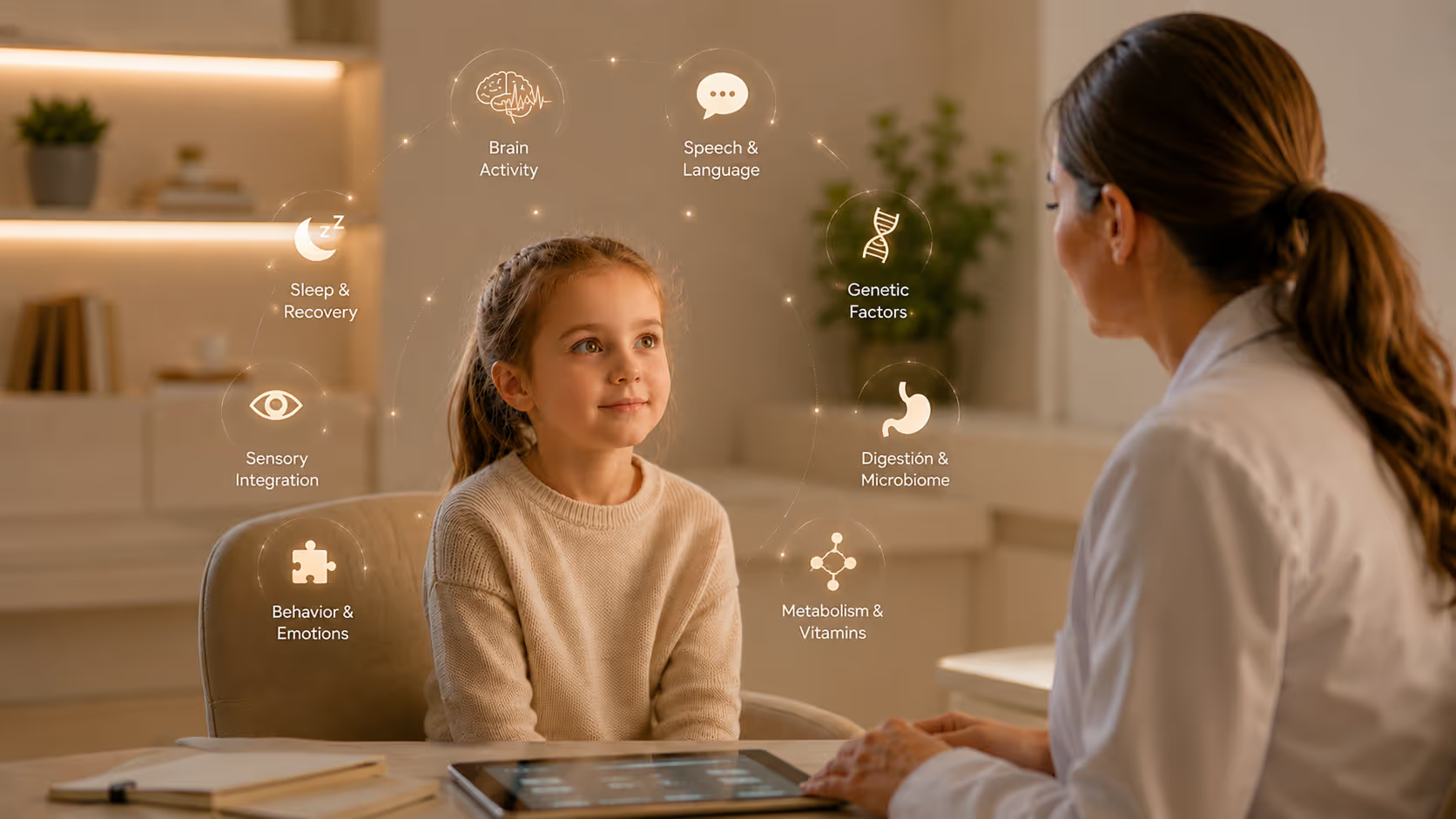
At KidiMind, we approach developmental delays as a unified developmental pathway: instead of fragmented consultations, we conduct simultaneous assessment of brain function, speech, motor skills, behavior, genetics, metabolism, and environmental factors. We move quickly from asking "why is there a delay?" to "what exactly can we do right now?"
Developmental delay means falling behind age-expected milestones in one or more areas of development
Developmental delay means a child is falling behind age-expected milestones in speech and language, motor skills, cognitive development, adaptive functioning - or in several areas at once (global developmental delay).The core principle of leading global practices: early identification, earliest possible start of intervention, and searching for the underlying cause—not waiting to see if the child will "catch up on their own."
Sometimes a child does catch up. But if the delay has a specific cause - sensory, neurological, genetic, metabolic - lost time works against the child. The earlier support begins, the greater the brain's plasticity, and the more lasting the outcomes.

Types of developmental delays
These signs are not a diagnosis - but they are a reason to seek a professional evaluation. If you notice one or two signs, keep an eye on them. If several appear together, schedule a consultation.

Speech and language delay - Dyslexia
A child lags behind in understanding speech, vocabulary, phrase use, or communicative initiative. This is the most common reason parents seek help.

Motor development delay
Lag in gross and fine motor skills, coordination, postural control, and motor maturity.

Cognitive development delay
Lag in cognitive skills, thinking, learning capacity, and understanding cause-and-effect relationships.
Global developmental delay
Delay across multiple domains simultaneously. Requires thorough investigation to identify underlying causes - genetic, metabolic, or neurological.
Signs of developmental delays by age
These reference points are not a diagnosis - but a reason to seek a professional evaluation. With developmental delays, hesitation costs more than an "extra" consultation.

Under 12 months
- Doesn't hold head up, sit, or crawl on schedule
- Doesn't respond to sounds or voice
- Doesn't coo or babble
- No eye contact or responsive smiling
- Lethargy or, conversely, constant body tension


1–3 years
- Not walking by 18 months
- No single words by 18 months, no phrases by 2–2.5 years
- Doesn't understand simple requests
- Doesn't point to objects, doesn't imitate
- No interest in play or other children
3–6 years
- Speech significantly poorer than peers'
- Difficulty with dressing, eating, self-care skills
- Doesn't absorb basic concepts (colors, shapes, counting)
- Clumsiness, frequent falls, fine motor difficulties
- Challenges in preschool, unable to keep up with the group

What can underlie developmental delay
Developmental delay is not a diagnosis in itself, but a symptom. Behind it can lie a wide range of causes, and the task of diagnostics is to identify the specific one.
Possible causes:
- Sensory - hearing or vision impairment that interferes with speech and cognitive development
- Neurological - differences in brain maturation and function
- Genetic and chromosomal - syndromic and monogenic causes, especially in global developmental delay
- Metabolic - inborn errors of metabolism, deficiencies in vitamins, minerals, amino acids
- Autism spectrum disorders - delay may be part of a broader profile
- Deprivation and environment - lack of enriching interaction
- Combination of factors - most often, it is precisely a combination that is at play
Important: in some cases, the delay has a reversible or correctable cause - for example, iron deficiency, reduced hearing, or insufficient stimulation. This is exactly why comprehensive diagnostics are so important.


Take the first step
Book an initial consultation. In a single session, we'll gather your child's history, outline working hypotheses, and explain the support pathway that fits your child's unique needs.
Carrer Viladomat 135, 1-1, Eixample, 08015, Barcelona
Mon-Fri 10AM-6PM
Mon-Fri 10AM-6PM
Developmental delay cannot be addressed blindly
If we work only with the symptom- for example, "catching up speech" with a speech therapist - but don't look for the underlying cause, progress will be slow or unstable. Reduced hearing, iron deficiency, sensory differences, a genetic syndrome -each of these causes requires its own approach.
That's why, in cases of developmental delay, we simultaneously:
- search for the cause (genetics, metabolism, hearing, vision, neurology)
- assess all affected domains (speech, motor skills, cognition, behavior, sensory processing)
- address biological factors that are slowing development
- launch early intervention without waiting for all test results
This allows us not to lose time - the most valuable resource in developmental delay.
What we do differently
Individual pathway for every child: from addressing challenges to maximizing potential.

Searching for the cause, not just the symptom
Genetics, metabolism, hearing, vision, neurology - we identify what exactly underlies the delay and work with that.
Early start without waiting
Early developmental intervention begins in parallel with diagnostics - during the period of maximum brain plasticity.
All domains in one pathway
Speech, motor skills, cognition, sensory processing, behavior -assessed and addressed by the team simultaneously, without fragmented consultations.
Family as a progress accelerator
Parent coaching and home routines bring therapy into daily life and speed up skill generalization.
How we diagnose developmental delay
The goal of diagnostics is not simply to confirm "there is a delay," but to understand which domains are lagging, why, and what to do about it.
Basic assessment (for all children):
- Developmental and neuropsychological evaluation - which domains are delayed and which strengths can be leveraged for compensation
- Speech and language assessment - for any concerns about speech delay, receptive language, communicative initiative, or play development
- Sensory-motor and OT evaluation - challenges with regulation, praxis, self-care, participation in daily life
- Motor assessment - level of gross and fine motor skills, coordination, postural control, motor maturity
- Hearing and vision screening - mandatory in developmental delay to avoid missing a sensory cause
Extended assessment (when indicated):
- Genetic evaluation - in cases of global delay, dysmorphic features, seizures, congenital anomalies; current ACMG guidelines support early consideration of exome/genome sequencing
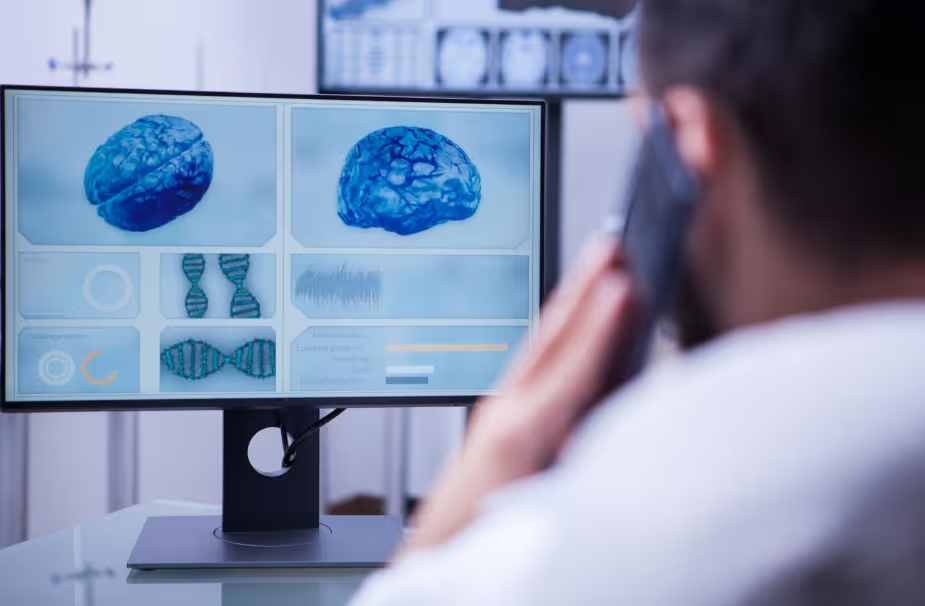
- Metabolic panel - basic and advanced testing to identify vitamin, mineral, amino acid deficiencies, or energy metabolism issues
- Microbiome and GI assessment - for food selectivity, constipation, pain, poor weight gain
- Food tolerance testing - for pronounced reactions to specific foods
- QEEG - to describe regulatory patterns, attention, and learning readiness
- Toxic exposure assessment - when significant environmental history is present
How we address developmental delay - a comprehensive program
The specific set of modules is tailored to the child's profile and the domains affected.

Early developmental intervention
- Delivers maximum impact during the period of high brain plasticity
- Launched early, without waiting for deficits to deepen
Speech and communication
- Speech therapy - receptive language, vocabulary, phrases, communication
- Developing the ability to use speech for interaction
Cognitive development
- Cognitive rehabilitation - foundational cognitive skills, school readiness, task persistence
Sensory processing and independence
- Sensory integration and OT - regulation, daily living skills, praxis, environmental tolerance
- Montessori room and Occupational Therapy - translating skills into real-world independence
Motor skills and body awareness
- Physiotherapy and kinesiotherapy - strength, balance, posture, coordination, gait, motor maturity
Neurotechnologies (when indicated)
- Neurofeedback - stabilizing attention and learning readiness
- VR modules - supportive environment for motor, attention, and cognitive tasks
- tDCS and photobiomodulation - to enhance neuroplasticity
Biomedicine and nutrition
- Functional nutrition - feeding, appetite, weight gain, energy, neurometabolic support
- Correction of vitamin, mineral, and amino acid deficiencies
- Microbiome support and GI profile management
- Food intolerance management
Family support
- Parent coaching - integrating therapy into the child's daily routines, accelerating skill generalization
How often and for how long
No child receives "everything" - the plan is built around their specific profile. This is a typical set of modules used in ASD support.
01
Intensity
2–4 visits per week. For pronounced global developmental delay - 3–5 visits per week in a mixed format.
02
Parent module
Required. Home routines accelerate skill transfer and consolidate progress.
03
Duration
Long-term support, with mandatory plan review every 8–12 weeks during the team's case conference.
What changes as a result of therapy
Outcomes depend on the cause of the delay, its severity, and how early intervention begins. We work toward helping your child:
- narrow the gap with age-expected milestones in affected domains
- develop speech and alternative communication methods
- acquire motor and daily living skills
- build cognitive foundations and school readiness
- become more independent in everyday life
- adapt more successfully to preschool or school settings
When causes are correctable (deficiencies, reduced hearing, insufficient stimulation), progress can be significant. With genetic or neurological causes, the goal shifts to maximizing functional abilities and quality of life.
Progress is tracked using specific standardized scales - every 8–12 weeks.
Case from practice
2.5-year-old girl, speech and motor development delay. At intake: no single words, unsteady walking, doesn't follow simple requests; parents were told "wait until age three, she'll start talking."
Standard path prior to us: Waiting + once-weekly speech therapy, where the therapist "couldn't establish contact."
What we did at KidiMind:
- Comprehensive assessment - developmental evaluation, speech, motor skills, mandatory hearing screening, metabolic panel
- Identified bilateral moderate hearing loss + iron and vitamin D deficiency
- Referral to ENT for hearing correction, nutritional correction of deficiencies
- Early intervention launched in parallel: speech therapy, sensory integration, physiotherapy, parent coaching
Results after 8 months:
- After hearing correction and addressing deficiencies, speech began developing actively
- Phrase speech emerged
- Confident walking, improved coordination
- Girl enrolled in mainstream daycare and adapted successfully
Key takeaway from the case: without hearing screening, speech therapy would have stalled for years.
Name changed, no photo used. Case published with written consent from the family.

Frequently asked questions from parents about developmental delay treatment
Every module of our program is regularly reviewed for effectiveness. If a specific method isn't delivering expected progress, we adjust it - without waiting for it to "maybe work someday."
My child is just a "late bloomer." Maybe they'll catch up on their own?

Some children do catch up. But if the delay has a specific cause - reduced hearing, a deficiency, sensory or neurological differences - waiting works against the child. Diagnostics precisely answers the question: is intervention needed, or is observation enough?
At what age can correction begin?
The earlier, the better. Early intervention is most effective during the period of high brain plasticity - that is, in the first years of life. We work with children from an early age.
How much does developmental delay diagnosis cost?
The cost depends on the scope. The basic developmental and speech assessment is an accessible entry point. Full pricing details are available in the "Prices" section.
Is genetic testing necessary for developmental delay?
Not always. It is indicated primarily in cases of global delay, dysmorphic features, seizures, or congenital anomalies. The decision is made during consultation after the initial evaluation.
How is developmental delay different from autism?
These are different conditions, although they can overlap. Delay means lagging behind in developmental domains; ASD involves specific differences in social communication and behavior. Sometimes delay is part of an ASD profile, sometimes it isn't. Diagnostics helps distinguish between them.
Is hearing screening mandatory if the problem is speech-related?
Yes, absolutely. Reduced hearing is one of the most commonly missed causes of speech delay. Speech therapy without addressing hearing issues is ineffective.
Can this be combined with preschool or other activities?
Yes. Moreover, successful adaptation in preschool is often one of the program's goals. We can provide recommendations for teachers.
Do you work with Russian-speaking families?
Yes. Part of our team speaks Russian, Spanish, and English. All consultations can be conducted in Russian.
Take the first step
Book an initial consultation at KidiMind. In a single session, our team will gather your child's history, outline clinical hypotheses, and propose a clear, targeted ASD diagnostic plan - nothing extra, no guesswork.
Carrer Viladomat 135, 1-1, Eixample, 08015, Barcelona
Mon-Fri 10AM-6PM
Mon-Fri 10AM-6PM