


From in-depth assessment to comprehensive therapy - all under one roof.
Child psychodiagnostics in Barcelona — in your native language, without waiting lists
A full range of internationally recognised assessment tools: WISC-V, ADOS-2, ADI-R, NEPSY-II, Conners-3, and more. Testing available in English, Spanish, Ukrainian or Russian. Official reports for schools, specialists, and government authorities. Appointments available within a week — not a six-month wait.
International diagnostic tools
We use only validated international methodologies — those applied in clinical practice worldwide and recognised by schools, specialists, and government authorities.
Test | What it assesses | Duration | |
|---|---|---|---|
1 | WISC-V | Intelligence (IQ), verbal comprehension, visual-spatial skills, working memory, processing speed | 2–3 hours |
2 | ADOS-2 | Assessment of autism spectrum disorders (ASD) | 40–60 minutes |
3 | ADI-R | Comprehensive parent interview when ASD is suspected | 2–3 hours |
4 | NEPSY-II | Neuropsychological assessment: attention, memory, executive functions, language, social perception, sensorimotor skills | 2–4 hours |
5 | Conners-3 | ADHD symptoms, behavioural and learning difficulties | 20–30 minutes |
6 | BRIEF-2 | Executive functions in everyday life | 15–20 minutes |
7 | BASC-3 | Emotional and behavioural characteristics, adaptive functioning | 20–40 minutes |
8 | Leiter-3 | Non-verbal intelligence (for children with speech difficulties) | 45–90 minutes |
9 | Raven's Progressive Matrices | Non-verbal reasoning and intelligence | 30–45 minutes |
10 | ROCF (Rey–Osterrieth Complex Figure) | Visual-spatial memory and executive functions | 20–30 minutes |
11 | CBCL (Achenbach) | Emotional and behavioural problems | 20–30 minutes |
12 | CDI-2 | Depressive symptoms in children and adolescents | 15–20 minutes |
13 | MASC-2 | Anxiety in children and adolescents | 20–30 minutes |
14 | RCADS | Anxiety and depression | 15–20 minutes |
15 | YSR | Adolescent self-assessment of emotional and behavioural difficulties | 20–30 minutes |
The specific battery of tests is selected during the initial consultation, based on the family's concerns and clinical hypotheses. We do not administer «everything on the list» — only what will answer your questions.
Five reasons to undergo psychodiagnostics
Psychodiagnostics is not about «labelling a child». It is a tool that answers specific questions and unlocks concrete opportunities.
Identify the root causes of difficulties, recognise your child's strengths, and determine whether their traits are linked to ADHD, autism, learning disorders, anxiety, or other conditions. For many families, diagnostics finally ends years of uncertainty.
Based on the results, we create an individualised therapy plan with specific recommendations for the family, school, and other professionals. Without diagnostics, therapy becomes a process of trial and error.
An official report helps justify the need for educational accommodations and adjusted learning conditions based on your child's neurodivergent profile. This is your evidence-based argument when speaking with the school.
Distinguish developmental differences from «laziness», «bad behaviour», or lack of motivation — and start effective support in time. Too many children live for years with the label «lazy» when they actually have real neurobiological differences.
Follow-up assessments allow you to evaluate the effectiveness of therapy and adjust the support plan if needed. Progress should be measurable.
How we differ from CDIAP and CSMIJ
Many families in Catalonia are familiar with public services:
- CDIAP (Centre de Desenvolupament Infantil i Atenció Precoç) — the public early intervention service for children from birth to age 6 with developmental delays or differences.
- CSMIJ (Centre de Salut Mental Infantil i Juvenil) — the public child and adolescent mental health service for those under 18, providing diagnosis and treatment for mental and emotional disorders.
These are essential and valuable services. We do not replace them — we address two challenges that families most frequently encounter.
Your child's and family's language
We conduct assessments in Russian, Ukrainian, Spanish, or English — in the language your child thinks and speaks most comfortably.
This is fundamental for accurate results. Testing in a non-native language measures not so much the child's abilities as their language proficiency. A child who arrived in Spain a year ago may score lower on verbal subtests — and receive an incorrect diagnosis.
We remove language and cultural barriers — and obtain a true picture of your child's profile.
No waiting lists
In the public system, the time from referral to comprehensive diagnostics can range from several months to a year. For a child in a period of active development, this is critically lost time.
With us, appointments are available within a week. Comprehensive diagnostics are typically completed in 2–4 weeks. The official report is issued immediately after the team reviews the results.
Take the first step
Book an initial consultation. In one visit, we will gather the medical history, outline our hypotheses, and explain which pathway is needed specifically for your child.
Carrer Viladomat 135, 1-1, Eixample, 08015, Barcelona
Mon-Fri 10AM-6PM
Mon-Fri 10AM-6PM
When testing makes sense
Diagnostics are not necessary for everyone. Here are the situations where testing truly provides answers.

School and learning
- The school reports concerns about behaviour, attention, or academic performance
- The child is underperforming relative to their potential
- Difficulties with reading, writing, or mathematics
- Official school accommodations are needed
- Decisions are being made about grade placement, retention, or specialised programmes


Development and behaviour
- Suspected ADHD, autism, or learning disorders
- Speech or motor delays
- Behavioural challenges at home or in kindergarten
- Difficulties interacting with peers
- Regression — the child has «lost» skills they previously had

Emotions and adaptation
- Anxiety, fears, or school refusal
- Low mood, loss of interest (especially in adolescents)
- Adjustment difficulties after relocating to Spain
- Need to distinguish between adaptation stress and a clinical disorder
- An objective assessment is needed before starting therapy
How testing works — four steps
Without stress or rush. We have designed the process to be comfortable for the child and as clear as possible for parents.

Initial consultation
We discuss the family's concerns, gather medical history, and review observations from parents and school. We formulate clinical hypotheses and select the specific battery of tests. 60 minutes.

Testing session
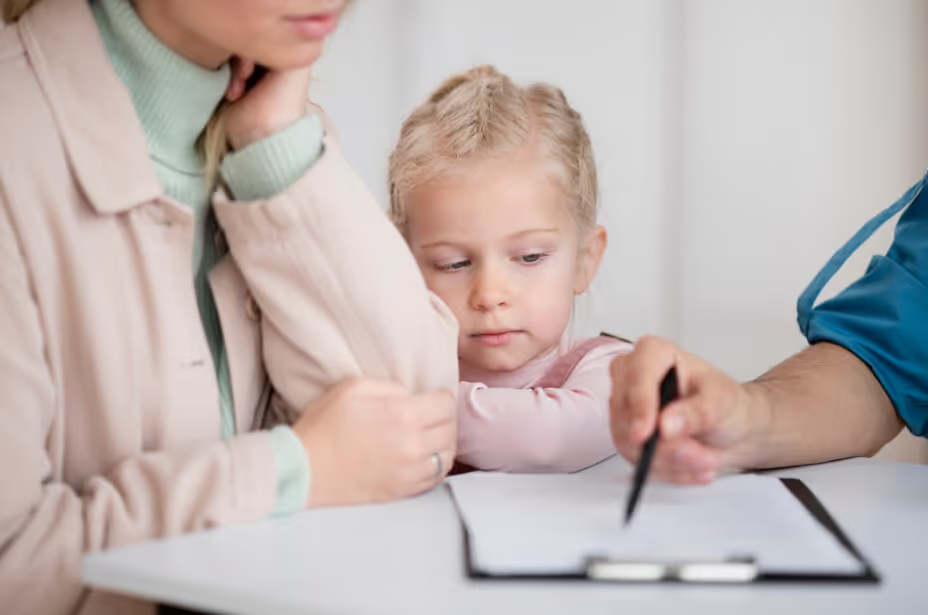
Assessment is structured as playful interaction, not an «exam». Parents and teachers complete questionnaires. If preferred, a tutor or your child's coach can provide input instead of the school.
Team review and analysis
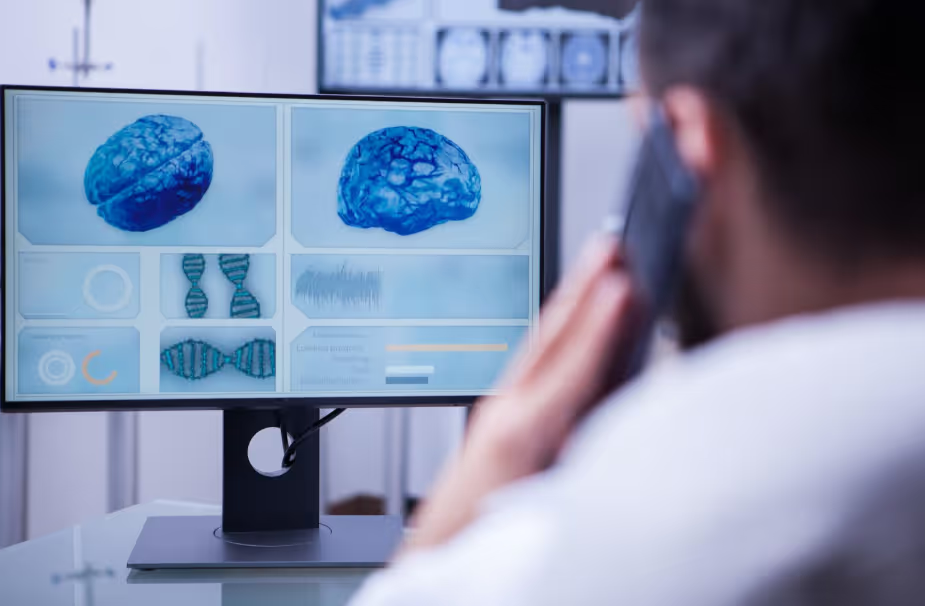
The psychologist processes the results; if needed, a case conference is held with the neurologist, speech therapist, and other specialists. We build a holistic picture — not just a set of numbers.
Report and recommendations
Meeting with the family: we review the results in detail and answer all questions. You receive an official written report and a concrete action plan — what to do next.
What you receive after diagnostics
Individual pathway for each child: from correcting impairments to maximising potential.

Official written report
A structured document outlining your child's profile across all assessed domains, test results, diagnosis or working hypotheses, and rationale for conclusions. Signed by a licensed specialist with their professional registration number (número de colegiado).
Recommendations for school
A separate document for teachers: what accommodations are needed, how to present material, which pace and task format suit your child best. This is your evidence-based tool when speaking with the school. Often, schools themselves refer for diagnostics — they are interested in understanding the root of difficulties and learning how to support your child effectively.
Support plan
Concrete next steps: whether therapy is needed, what type, at what intensity, which goals we set, and how progress will be measured.
Recommendations for families
What to do at home: routines, environment, approach, what to avoid. Practical and actionable from day one.
Why diagnostics in the native language are more accurate
This is not a matter of comfort — it is a matter of result validity. Most test tasks are timed.
What happens when testing is conducted in a non-native language:
- Verbal subtests are underestimated. A child may know the answer but lack the vocabulary to express it. As a result, IQ scores appear lower than the child's actual ability.
- Instructions are misunderstood. The child performs a different task than the one intended — and the result becomes distorted.
- Anxiety increases. Testing in an unfamiliar language is stressful. An anxious child performs below their true potential.
- Cultural references do not translate. Some items rely on context familiar to local children but not to a child who has recently emigrated.
- Risk of misdiagnosis. Language delays may be mistaken for intellectual delays. Quietness due to uncertainty may be misinterpreted as autistic traits.
- We conduct testing in the language your child thinks in — and obtain their true cognitive profile, not a profile of their Spanish proficiency.

Frequently asked questions about psychodiagnostics
We have compiled answers to the most important questions to ease your concerns and clarify all details of the process before you book.
How long is the waiting time for an appointment?

Usually 5–7 days. Comprehensive diagnostics take 2–4 weeks, depending on the scope of testing.
Do schools accept your report?
Yes. The report is signed by a licensed specialist with their professional registration number (número de colegiado) and formatted according to standards accepted in Catalonia. We also prepare a separate document with recommendations specifically for teachers.
Can we be on the CDIAP/CSMIJ waiting list and undergo diagnostics with you at the same time?
Yes, and this is often a sensible approach. Our report can be shared with public-sector specialists — it does not replace their work but provides them with a ready-made clinical picture. Many families begin working with us without losing their place in the public queue.
In which language is testing conducted?
In Russian, Ukrainian, Spanish, or English — at the family's choice. For bilingual children, we can combine languages across different subtests when methodologically appropriate.
How much does diagnostics cost?
It depends on the battery of tests. Individual assessments start from €90; comprehensive packages by diagnostic category start from €850. Exact prices are listed in the «Fees» section.
Is it possible to take only one test?
Yes. Sometimes a single tool is sufficient — for example, Conners-3 to assess ADHD symptoms.
However, for diagnostic conclusions, a combination of data is almost always required: one test alone is rarely definitive.
From what age can a child be tested?
From 2–3 years old for developmental and autism-related assessments. WISC-V is applicable from age 6. Each tool has its own age range; we select the appropriate ones during the consultation.
What if testing does not confirm a suspected diagnosis?
This is a normal and often highly valuable outcome. The family gains clarity that the difficulties stem from other causes, and receives a tailored support plan. We do not assign diagnoses «just in case».
My child is afraid of tests. What should we do?
Diagnostics are structured as playful interaction, not an exam. The psychologist first builds rapport, and only then moves on to tasks. If the child is not ready, we reschedule for the next session.
Should I prepare my child for testing?
No special preparation is needed. It is enough that the child is well-rested, has eaten, and is not overloaded with activities that day. Avoid saying «you will be tested» — it is better to frame it as «you will play some interesting games with the psychologist».
Get answers, not guesses
One consultation — and you will understand which diagnostics your child needs and what they will reveal. Appointments available within a week, testing in your native language, official report.
Carrer Viladomat 135, 1-1, Eixample, 08015, Barcelona
Mon-Fri 10AM-6PM
Mon-Fri 10AM-6PM